
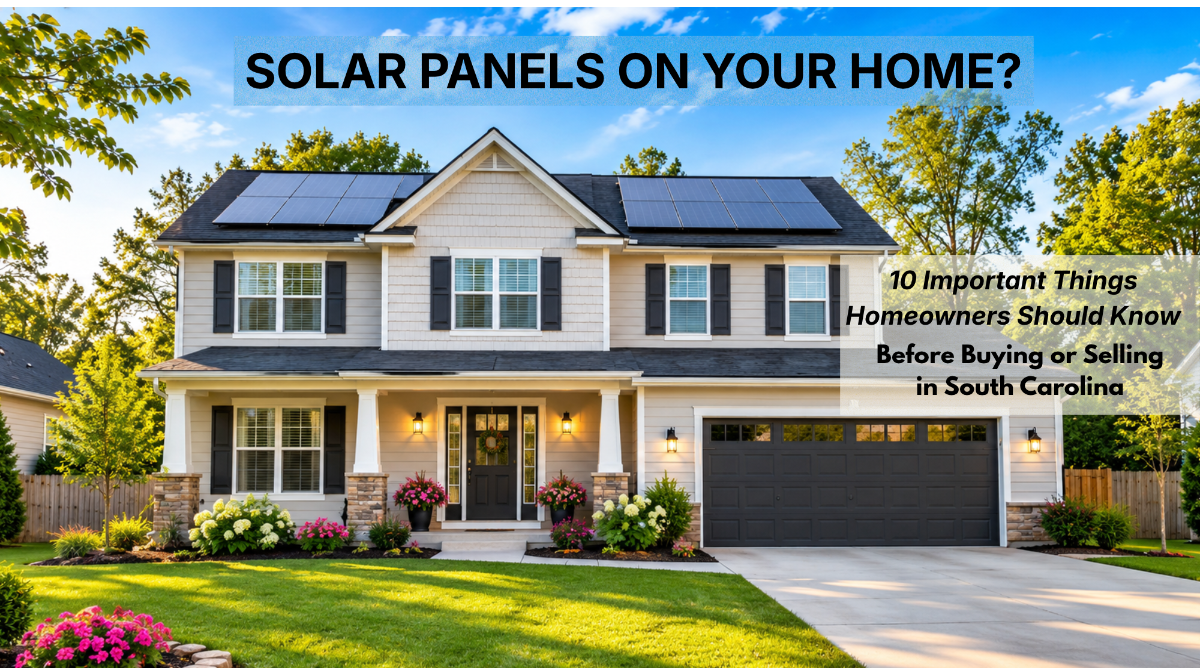
Solar Panels on Your Home? 10 Important Things Homeowners Should Know Before Buying or Selling in South Carolina
Solar Panels on Your Home? 10 Important Things Homeowners Should Know Before Buying or Selling in South Carolina
Solar panels can look like a fantastic addition to your home. Lower electricity bills, cleaner energy, and the possibility of long-term savings sound pretty appealing, right?
But before you install solar panels or purchase a home that already has them, there are a few things worth checking.
What happens if you decide to sell the house? Who actually owns the panels? What if the solar company goes out of business? Can a buyer take over your solar agreement? And could an outstanding solar loan complicate your closing?
These are important questions, especially if you're buying or selling a home in Lexington, Columbia, Irmo, Chapin, Blythewood, West Columbia, or around Lake Murray.
Here's something many homeowners don't realize: The solar panels themselves aren't always the biggest consideration. The agreement attached to them can be just as important.
A solar system might be fully paid off, financed through a loan, leased from a company, or covered by a Power Purchase Agreement (PPA). Each arrangement can have different financial responsibilities and rules when ownership of the home changes.
At The Sherpa Group Team at Real Broker, LLC, led by Nima Sherpa, REALTOR® Associate Broker and Team Leader, we believe that understanding every detail of a property is an important part of making informed real estate decisions.
So, whether you're thinking about installing solar panels, buying a solar-powered home, or preparing to sell your property in the Midlands of South Carolina, let's walk through 10 important things you should know before making your next move.
1. Who Actually Owns Your Solar Panels?
Before worrying about electricity savings or resale value, start with one simple question: Who owns the solar panels on the roof?
It might seem obvious that the homeowner owns anything attached to the house. However, that's not always the case.
There are four common ways homeowners acquire solar panels.
Understanding the four solar ownership arrangements
|
Arrangement |
Who owns the panels? |
What it means for you |
|---|---|---|
|
Cash purchase |
Homeowner |
You own the system outright. |
|
Solar loan |
Usually homeowner, subject to loan terms and security interests |
You make monthly loan payments. |
|
Solar lease |
Solar company |
You pay to use the equipment. |
|
Power Purchase Agreement (PPA) |
Solar provider |
You pay for the electricity the system produces under the agreement. |
Let's make this a little easier.
Cash purchase: You pay for the system upfront. Once installed and paid for, you generally own the equipment.
Solar loan: You finance the purchase through a lender. You generally own the panels, but the lender may have a security interest in the equipment.
Solar lease: A solar company owns the equipment, and you pay a monthly amount to use it.
Power Purchase Agreement (PPA): You typically don't own the panels. Instead, you agree to purchase the electricity they generate at a specified rate.
Why does this matter when selling?
Because a buyer purchasing a home with fully paid-off solar panels faces a different situation than someone purchasing a home with a 20-year solar lease or an outstanding loan.
In South Carolina, solar lease providers are subject to state consumer protection and certification requirements. Homeowners should review the agreement carefully and verify the provider's status.
The takeaway: Before signing a solar agreement or listing your home, find out exactly who owns the equipment and what obligations come with it.
2. Solar Loans Don't Automatically Disappear When You Sell
Here's a situation that can surprise homeowners.
You installed solar panels five years ago. You've enjoyed lower electricity costs, but you still have several years of loan payments remaining.
Now you're ready to sell your home.
What happens to that loan?
Unfortunately, selling the house doesn't automatically eliminate your outstanding solar debt.
A solar loan is generally a separate financial obligation. Depending on the agreement, the seller may need to:
-
Pay off the remaining loan balance before or at closing.
-
Obtain the lender's approval for another arrangement.
-
Determine whether the buyer can qualify to assume the loan, if assumption is permitted.
-
Resolve any security interest or filing affecting the property or solar equipment.
Buyers should never assume they automatically inherit a seller's personal solar loan.
A simple example: How a solar loan affects your proceeds
Imagine you're selling your home in Lexington, SC.
Example seller proceeds
Estimated sale price
$350,000
Mortgage payoff
$240,000
Remaining solar loan
$15,000
Estimated closing costs and selling expenses
$20,000
Estimated proceeds
$75,000
Illustrative example only. Actual proceeds depend on the contract, loan payoffs, commissions, taxes and other closing expenses.
Without the outstanding solar loan, the seller's estimated proceeds would be $90,000 instead.
That's a $15,000 difference!
This is why obtaining an accurate solar loan payoff statement early is so important.
A helpful tip: If you're planning to sell a solar-powered home, ask your solar lender about payoff requirements before putting the property on the market.
3. What Happens If Your Solar Company Goes Out of Business?
This is one of the biggest questions homeowners should ask before entering a long-term solar agreement.
Imagine this: You purchased solar panels from a company that promised decades of clean energy and savings. A few years later, you discover the company has gone bankrupt.
Now what?
The answer depends on which company closed and what responsibilities it had under your agreement.
Scenario A: The installation company closes
Suppose the company that installed your panels shuts down.
The good news is that the panels don't automatically become useless or disappear.
However, you may lose access to the original installation company's customer service, maintenance department or workmanship support.
You may need to find another qualified solar contractor to inspect or repair the system.
Scenario B: The financing company goes bankrupt
What if the lender financing your solar installation closes?
Your outstanding debt generally does not disappear simply because the lender enters bankruptcy.
Depending on the circumstances, your loan may be transferred, sold or serviced by another company.
You should receive information about where to make payments and how to contact the new loan servicer.
Important: Don't stop making payments just because you hear that a company has filed for bankruptcy. Verify payment instructions through official communications and appropriate financial channels.
Scenario C: The solar lease or PPA provider closes
This situation can be more complicated.
If a third-party company owns your solar panels under a lease or PPA, the agreement may involve obligations beyond simply making monthly payments.
A bankruptcy, sale or restructuring could affect:
-
Who manages your account.
-
Where payments are sent.
-
Who handles maintenance.
-
Who responds to equipment problems.
-
How a future home sale or contract transfer is handled.
The agreement and bankruptcy proceedings determine what happens. Don't assume the contract automatically ends or transfers to another company.
Scenario D: The equipment manufacturer closes
What if the company that manufactured your panels or inverter goes out of business?
Your equipment may continue working perfectly well.
However, warranty service and replacement parts could become more difficult to obtain.
Some warranties may be supported by another company, an insurer or a separate warranty provider, but that should never be assumed.
What should homeowners do?
If a solar company closes, take these steps:
-
Save your original contract and payment records.
-
Contact your loan servicer or lease provider to verify the account status.
-
Review the warranty documents and identify the actual warranty provider.
-
Keep records of your system's production and maintenance.
-
Find a qualified solar technician if repairs are needed.
-
Consult a qualified attorney if bankruptcy proceedings or contractual disputes affect your rights.
The big lesson: A solar company going out of business doesn't necessarily mean your solar system is a bad investment. But it makes having complete documentation even more important.
4. Can Solar Panels Create Problems When Selling Your Home?
Absolutely, they can create extra steps. But that doesn't mean selling a solar-powered home is impossible.
The biggest challenge is usually making sure the buyer, lender, title company and solar provider are all on the same page.
Consider this example.
You're selling your home in Chapin, SC. Your solar panels are leased through a company, and the agreement has 14 years remaining.
A potential buyer loves the house, likes the idea of lower electricity costs, and is ready to make an offer.
Then they discover that taking over the solar lease requires a credit review and approval from the solar provider.
Suddenly, the buyer has another decision to make.
They may be perfectly comfortable with the house but uncomfortable with a long-term solar commitment.
This is why solar agreements should be discussed early in the transaction.
Watch out for these potential complications
1. Solar lease or PPA transfers
Some agreements allow a buyer to take over the existing contract, but the buyer may need to meet certain credit requirements or receive provider approval.
2. Outstanding solar loans
The seller may need to pay off the remaining balance or arrange an acceptable alternative before closing.
3. UCC-1 financing statements
A UCC-1 is a public financing statement that gives notice of a claimed security interest in personal property.
Some solar lenders file UCC statements against the equipment. Others may record fixture filings in real estate records.
These are not automatically the same as a mortgage lien on the entire property.
However, they can matter when a title company or mortgage lender reviews the transaction.
South Carolina's Secretary of State provides a public UCC filing and search system.
4. Mortgage lender requirements
Buyers' lenders may request solar contracts, loan documents, payoff information and details about any recorded security interests.
Fannie Mae and Freddie Mac have specific requirements depending on whether the panels are owned, leased, or separately financed.
5. Closing delays
Missing contracts, unclear ownership or unresolved security interests can slow down the closing process.
Our advice: If you're selling a home with solar panels in Lexington County or Richland County, don't wait until the closing attorney asks for the paperwork. Start gathering it when you begin preparing your home for sale.
5. Will Solar Panels Increase Your Home's Value?
This is probably one of the first questions homeowners ask.
After spending thousands of dollars on a solar installation, naturally, you want to know whether that investment will pay off when you sell.
The honest answer? Solar panels can add appeal to a home, but they don't automatically increase its market value.
Let's look at both sides.
Potential advantages
-
Lower electricity expenses: Buyers may appreciate documented savings on utility bills.
-
Owned equipment: Fully paid-off solar panels can be attractive because the buyer isn't taking on a separate monthly agreement.
-
Energy efficiency: Some buyers actively look for homes with energy-efficient features.
-
Transferable warranties: Existing equipment protection can provide additional reassurance.
-
Long-term benefits: A properly functioning system may continue producing electricity for years.
Potential disadvantages
-
Expensive financing: Buyers may hesitate if the solar loan has a substantial remaining balance.
-
Leased equipment: Some buyers don't want another long-term contract.
-
Older equipment: Aging panels, inverters or batteries may require replacement.
-
Unclear savings: Without utility bills and production records, it's difficult to evaluate the system's financial benefits.
-
Complicated agreements: Transfer requirements and unexpected fees can make the property less appealing.
What about the appraisal?
An appraiser doesn't simply add the original installation cost to the home's value.
For example, spending $30,000 on solar panels doesn't mean your home is automatically worth $30,000 more.
Fannie Mae's appraisal guidance requires the market's reaction to energy-efficient improvements to be considered. The appraiser cannot assign value simply by adding installation costs or projected electricity savings.
For homeowners selling in Columbia, Irmo, Blythewood or around Lake Murray, the condition of the system, ownership arrangement and available comparable sales may all influence how the feature is viewed.
Remember: A solar system should be evaluated as part of the entire property, not as a guaranteed dollar-for-dollar investment.
6. Don't Forget About Your Roof!
Here's something homeowners sometimes overlook: Solar panels sit on your roof, but your roof won't last forever.
If your roof is already 15 or 20 years old when you install solar panels, you could face an expensive surprise sooner than expected.
Why?
Because replacing a roof with solar panels installed usually involves an additional step: removing the panels and reinstalling them afterward.
Questions to consider
-
How old is your roof?
-
Was the roof inspected before installation?
-
Were the mounting points properly sealed?
-
Does the installation company provide workmanship or roof penetration coverage?
-
Who pays to remove and reinstall the panels during roof replacement?
-
Does the solar agreement specify how long removal and reinstallation may take?
Imagine buying a home in Lexington with a relatively new solar system but an aging roof.
A few years later, you need a complete roof replacement.
You may have to coordinate with a solar contractor, arrange temporary equipment removal and pay for reinstallation.
That expense can add up.
A practical tip for homeowners: If your roof may need replacement within the next several years, consider taking care of it before installing solar panels.
For buyers, request roof inspection records and solar installation documentation before completing your purchase.
7. Understand Your Solar Warranties
Solar warranties can sound impressive, but not every warranty covers the same thing.
A system may have several separate warranties.
|
Warranty type |
What it generally covers |
|---|---|
|
Solar panel warranty |
Defects and certain performance-related issues |
|
Inverter warranty |
Problems with the equipment converting solar electricity |
|
Battery warranty |
Certain battery defects and performance limits |
|
Workmanship warranty |
Installation-related problems |
|
Roof penetration warranty |
Certain leaks or damage related to installation |
What happens if the installer closes?
This is where homeowners need to pay attention.
Your solar panel manufacturer's warranty may remain valid even if the original installer goes out of business.
However, the manufacturer's warranty doesn't necessarily cover installation mistakes, roof leaks or labor costs.
Similarly, an installation company's workmanship warranty may be difficult to enforce if that company no longer operates.
Before buying a home with solar panels, ask for:
-
Original installation documents.
-
Manufacturer warranty certificates.
-
Inverter and battery warranty details.
-
Workmanship warranty information.
-
Warranty registration and transfer requirements.
-
Contact information for the manufacturer and service provider.
Also, don't assume every warranty automatically transfers to the next homeowner.
Check the actual terms.
A good rule: Keep digital and printed copies of every solar-related document. Your future buyer may appreciate them more than you think!
8. Will You Still Receive an Electricity Bill?
Yes, you might!
One of the biggest misunderstandings about solar panels is that installing them means you'll never receive an electricity bill again.
That's not necessarily true.
Solar panels generate electricity when sunlight is available. Your home uses that electricity, and any excess may be sent back to the utility grid, depending on your system and utility arrangement.
But what happens at night or on cloudy days?
You may need to purchase electricity from your utility company.
Even with solar panels, you could still have charges for:
-
Electricity purchased from the grid.
-
Basic monthly service fees.
-
Connection or demand-related charges, where applicable.
-
Other charges included in your utility's tariff.
What about net metering in South Carolina?
Net metering is an arrangement where eligible homeowners receive credits for excess electricity their solar systems send back to the grid.
However, not all customers receive the same credit rates.
South Carolina's Solar Choice tariffs introduced different billing arrangements for newer residential solar customers. The applicable arrangement depends on the utility, enrollment date and tariff.
The South Carolina Office of Regulatory Staff explains that customers who applied for net metering from January 1, 2022, generally fall under the permanent Solar Choice Metering tariffs. Earlier enrollment dates can have different arrangements.
For homeowners in the Midlands, the relevant utility matters. Your arrangements may differ depending on whether your property is served by Dominion Energy, Duke Energy or an electric cooperative or municipal utility.
Before purchasing or installing a system:
-
Contact your electric utility.
-
Confirm the applicable solar tariff.
-
Ask about interconnection approval.
-
Understand how excess electricity is credited.
-
Review all monthly charges and fees.
The South Carolina Energy Office recommends contacting your utility early to understand its requirements and complete the necessary interconnection process.
Buyer's tip: Don't rely on a salesperson's estimated savings alone. Ask for actual electricity bills and solar production records covering at least the previous 12 months.
9. What About Homeowners Insurance and Financing?
Solar panels are a significant addition to your property, so don't forget to consider insurance and mortgage requirements.
Homeowners insurance
Before installing solar panels, contact your insurance provider.
Ask whether rooftop panels are covered under your existing homeowners policy or whether additional coverage is necessary.
Pay attention to:
-
Wind and storm damage.
-
Hail damage.
-
Fire-related damage.
-
Roof damage caused by installation.
-
Equipment replacement costs.
-
Coverage exclusions and deductibles.
This is particularly worth considering in South Carolina, where homeowners should understand their coverage for severe weather.
If the panels are leased or owned by a third party, clarify who is responsible for insuring the equipment and how the agreement handles damage.
Mortgage financing
Solar panels can also affect the mortgage approval process when someone purchases a home.
A lender may want to understand:
-
Who owns the panels.
-
Whether there is an outstanding solar loan.
-
Whether the equipment is collateral for a separate loan.
-
Whether a UCC filing affects the property or equipment.
-
Whether a lease or PPA must be transferred.
-
Whether the monthly payment affects the buyer's debt-to-income ratio.
Fannie Mae and Freddie Mac distinguish between owned, leased, PPA and separately financed systems.
For example, Freddie Mac's current guidance effective January 26, 2026, addresses how different solar arrangements are treated for appraisal, title and debt-to-income purposes.
The requirements can vary depending on the mortgage program and lender.
Conventional, FHA, VA and USDA financing should not be assumed to follow identical solar documentation or underwriting rules.
The takeaway: If you're buying a solar-powered home, let your mortgage lender review the solar agreement early in the process. Your closing attorney should also review any relevant title or security-interest issues.
10. What Should You Check Before Buying a Home with Solar Panels?
Found a beautiful home in Lexington, Chapin or Columbia with solar panels on the roof?
That's great! But before getting too excited about the possibility of lower electricity bills, make sure you understand exactly what you're purchasing.
Here's a checklist worth keeping.
Solar Home Buyer Checklist: 12 Things to Verify
Before you buy, verify these details
Don't forget to request copies of the original solar contract, payment history, warranty documents, installation permits and utility bills.
If you're considering a home with a solar lease or PPA, have the provider explain the transfer process in writing.
And before closing, let your lender and closing attorney review the relevant documents.
A little homework now can prevent some very frustrating surprises later.
A Quick Checklist for Home Sellers: Getting Ready to List a Solar-Powered Home
Planning to sell your home in South Carolina?
Whether you're listing in West Columbia, Lexington, Irmo or the greater Columbia area, getting your solar paperwork organized before listing can make the process much smoother.
Here's what to prepare.
Solar Home Seller Checklist: 10 Things to Prepare
Why do all this early?
Because a buyer's lender or closing attorney may need additional documentation before approving the transaction.
If there's a lease transfer, loan payoff or UCC filing that needs attention, discovering it weeks before closing is much better than discovering it two days before everyone is scheduled to sign.
A prepared seller is a seller who gives buyers fewer reasons to worry.
Frequently Asked Questions About Solar Panels and Real Estate
Here are answers to some common questions South Carolina homeowners and buyers ask.
1. Can I sell my house if I still owe money on solar panels?
Yes. Having an outstanding solar loan doesn't automatically prevent you from selling your home. However, you may need to pay off the remaining balance, obtain lender approval for an alternative arrangement or satisfy applicable security-interest requirements before closing.
2. Do buyers have to take over a solar lease?
No. Buyers don't automatically have to accept a seller's solar lease. Whether the agreement can be transferred depends on the contract, the provider's requirements and the buyer's willingness to accept it. Some providers require credit approval.
3. What happens to solar panels if the installation company goes bankrupt?
The panels generally remain installed and may continue working. However, installation support, maintenance and workmanship warranty services could be affected. Manufacturer warranties and financing obligations are separate matters and should be checked individually.
4. Do solar panels automatically increase home value?
No. Solar panels may make a property more attractive to certain buyers, especially when the system is owned and has documented electricity savings. However, the appraised value depends on market evidence, system condition, ownership and other property characteristics.
5. Can solar panels affect mortgage approval?
Yes, potentially. Lenders may review solar loans, monthly payments, leases, PPAs, ownership documents and UCC filings. The impact depends on the financing arrangement and the lender's applicable underwriting guidelines.
6. What happens to solar panel warranties when a company closes?
It depends on which company provided the warranty. A manufacturer's equipment warranty may remain valid even if the original installer closes, but workmanship coverage may become difficult to enforce. Always check the warranty provider, coverage period and transfer requirements.
Conclusion: Solar Panels Don't Have to Complicate Your Next Move
Solar panels can be a valuable feature of a home. They may offer electricity savings, renewable energy benefits and additional appeal to certain buyers.
But as we've covered, there's more to consider than what's sitting on your roof.
Ownership, financing, warranties, roof condition, utility arrangements and transfer requirements can all influence your experience when buying or selling a solar-powered home.
The good news? With the right information and preparation, these details can be addressed before they become problems.
If you're considering buying a home with solar panels, take time to understand the agreement before making an offer. And if you're preparing to sell, gather your documents and discuss the solar arrangement with your real estate professional early.
At The Sherpa Group Team at Real Broker, LLC, we believe informed homeowners make more confident real estate decisions.
Led by Nima Sherpa, REALTOR® Associate Broker and Team Leader, our team is here to help buyers and sellers navigate the real estate process throughout Lexington, Columbia, Lake Murray and the greater Midlands of South Carolina.
Thinking about buying or selling a home with solar panels?
Let's talk about your next move!
Important Consumer and Legal Resources
Before signing a solar agreement or completing a real estate transaction, consult the following official resources. These are particularly useful for South Carolina homeowners.
1. South Carolina Department of Consumer Affairs (SCDCA) – Solar consumer rights, required disclosures, contract information and complaints.
Thinking About Solar Energy – SCDCA
2. South Carolina Office of Regulatory Staff (ORS) – Solar leasing regulations, certified leasing companies and consumer protections.
Solar Leasing Consumer Protection Regulations
3. South Carolina Energy Office – Utility interconnection, net metering and solar installation guidance.
Working with Utilities · Tax Credits, Incentives and Net Metering
4. South Carolina Secretary of State – Public UCC financing statement searches.
5. Federal Trade Commission (FTC) – Consumer guidance on solar purchases, financing, leases and PPAs.
6. Fannie Mae Selling Guide – Mortgage requirements for properties with solar panels.
Special Property Eligibility Considerations
7. Freddie Mac Seller/Servicer Guide – Solar panel eligibility, appraisal, title and financing requirements.
A note for readers: This article provides general educational information, not legal, tax, insurance or financial advice. Solar contracts, bankruptcy proceedings, utility tariffs and mortgage requirements can differ. Consult your closing attorney, lender, utility provider, insurance professional or qualified solar contractor for advice concerning your particular situation.
Categories
Recent Posts